
The West Sacramento/Las Vegas/No Longer Oakland Athletics play at Sutter Health Park while they wait for their planned ballpark at the old Tropicana Las Vegas. They are planned to move into the new stadium after next season after spending the past 2 seasons in West Sacramento. So far, the triple A stadium has led to high offensive production given the smaller dimensions, and the heat of the Central Valley. Will Las Vegas planned ballpark have a similar effect?
Methodology: https://diamondbydata.com/how-well-will-each-round-1-hitter-fit-with-their-drafted-team/
For reference, we will be going off the dimensions of the new stadium:
#8 Drew Burress, CF – Athletics
Photo by Jason Getz / AJC
In his collegiate career, Drew Burress became Georgia Tech’s all time home run leader, hitting 60 home runs over 3 seasons. He was a consensus First Team All-American in 2025 and 2026. He also spent some time in the CCBL. His contact scouting grade is still good, at a 55, but his real strength is shown in his power grade of 60. He also hit 42% more doubles than the average round 1 draftee. His only thing is that he doesn’t hit a lot of singles, but that’s to be expected from a power hitter like Burress. He has slightly above average speed, coming in at a grade of 55.
As for the Athletics, we don’t know how their new planned Las Vegas Ballpark will affect hitting trends. However, with Burress tending to be a pull hitter, the new Vegas stadium’s left field wall distance of 340 feet would rank among the farthest in baseball. This could affect the amount of home runs that Burress would hit. The fixed roof over the planned stadium will probably show off Burress’ ability to hit doubles.
Overall Fit Grade: C+
#111 Roman Martin, SS – UCLA
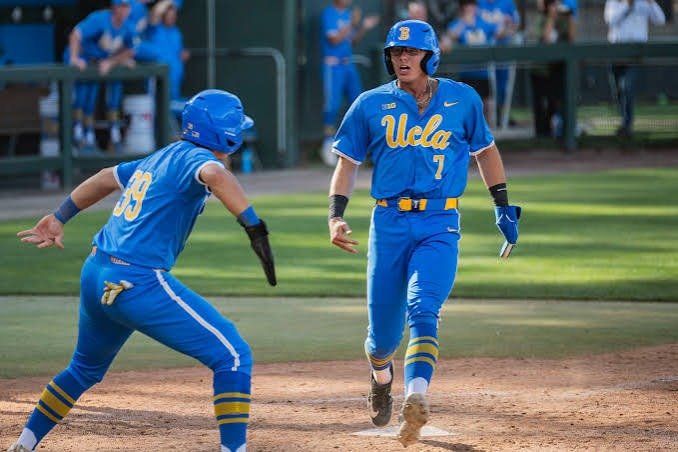
Photo by Kai Dizon/Daily Bruin
The contact hitter out of LA does has the ability to do big damage on balls on the inside despite being a contact hitter (50 contact scouting grade vs 45 power grade). He does GIDP rate is 46% higher than the average round 4 collegiate draftee, and his run scouting grade is only a 40.
With the desert heat in Las Vegas, the A’s new ballpark will be fully air conditioned, which is a plus, as contact hitters tend to benefit as the average temperature go down. Since the ballpark will have a fixed roof, pitchers will benefit from higher GIDP rates, so Martin shouldn’t have an abnormally high rate. However, with the new ballpark supposed to have higher walls, that usually encourages good baserunning, so that might be an area for concern.
Overall Fit Grade: C
#143 Alex Hernandez, 3B – Georgia Tech
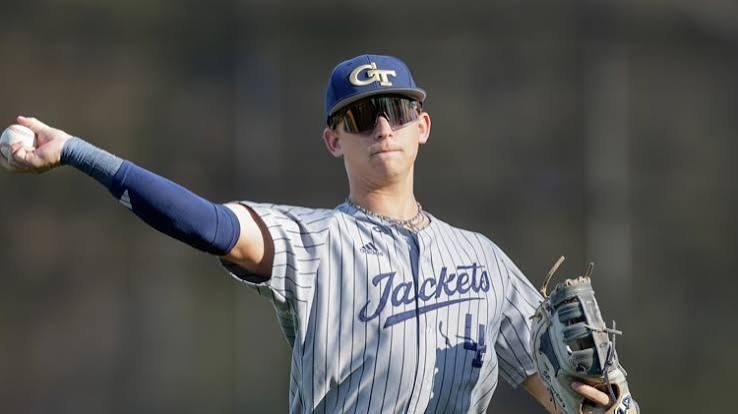
Photo by AP
The secret to Alex Hernandez’s ability to hit the ball to all areas of the field is keeping his hands inside of the ball. He’s a very balanced hitter, with even 50s for his scouting contacts and power grades. He hit 34% more triples than the average round 5 player drafted. However, he did hit 50% less triples, and hit nearly 3 times as many double plays than the average.
Las Vegas is supposed to be at one of the highest elevations in baseball, which is great for encouraging players to hit lots of triples, unlike Hernandez. We assume the “Las Vegas” Athletics will play more night games, as summer daytime highs are usually well into the 100s. Home runs rates tend to be higher in night games, which seems good for Hernandez. With the roof seemingly increasing the amount of double plays, Hernandez’s rate shouldn’t stand out.
Overall Fit Grade: B
#172 Alex Sosa, C – Miami
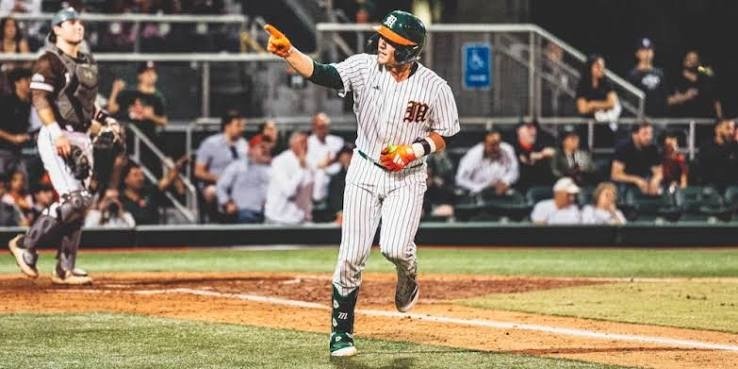
Photo by Miami Hurricanes Athletics
After spending 2 years at NC State, Sosa had a breakout season after transferring to Miami. An aggressive power hitter, he tends to pull the ball with an uppercut path. Despite throwing right, he bats left-handed. For his total collegiate stats, he hit about 30% more home runs than the average round 6 college player drafted, and 80% less triples. His run scouting grade is also only a 40.
Like with Alex Hernandez, Sosa will get to reap the benefits of having a high home runs rate, and may have to adapt his low triple rates. Also, like Roman Martin, his speed might be an issue with the high minimum height of the outfield walls. With the poles also being a far distance from home plate, it might be a challenge producing as a lefty pull hitter
Overall Fit Grade: D
#261 Tanner Marsh, 2B – Liberty
Photo by Liberty University Athletics
Reigning Conference USA Player of the Year, Tanner Marsh showed off his impressive contact skills, leading Liberty in batting average, hits, and runs score. Most of his contact went towards triples, as he hit about 69% more triples than the average round 9 collegiate player drafted. His contact tendencies were further established as his homerun rate is less than half the average rate. He also grounded into 47% more double plays. In 2025, he also received CCBL All Star Honors.
Unlike many hitters drafted by the Athletics, Marsh should be able to take advantage of the high elevation to continue to hit triples. Though he has the opposite problem, where he can’t take advantage of the potential night games to hit lots of home runs. His double play rate shouldn’t be super noticeably problematic though.
Overall Fit Grade: B-
#321 Javar William, OF – Wake Forest
Photo by Wake Forest
“High-contact outfielder who can pressure defenses and impact games in multiple ways” – Fanstake
Williams is an all fields, gap to gap line drive hitter. He spent one summer at each of the FCBL, PGCL, and CCBL. He earned Second-Team All-ACC Honors in his final season with the Demon Deacons. He hit about 50% more triples than the average round 11 collegiate draftee, but also hit 50% less doubles, and 4 times less home runs than the average.
“Dynamic, 80-grade runner who had some of the best pure speed in this year’s draft class” – Baseball America
Like Tanner Marsh. Javar Williams has a very similar situation with his high triple rate, and low home runs rate, being a contact hitter. As for his double rate, roofs tend to encourage more doubles, so Williams low rate might be noticable. He will get to benefit from the high minimum wall heights of the new planned ballpark, as his baserunning skills may come in handy down the stretch in games
Overall Fit Grade: C
#441 Dylan O’Connell, OF – Wisconsin-Milwaukee
Photo by Milwaukee Athletics
“O’Connell is patient at the plate and is able to make solid contact on the baseball… Consistently makes hard contact on the barrel… Intriguing offensive profile with a top-of-the-order ceiling.” – Prep Baseball
After playing 1 season at St. Thomas, Dlyan O’Connell transferred to Western Kentucky for 2 years, before playing at Milwaukee for his final collegiate season. He also spent 2 summers at the NWDS. He also has a low GIDP rate, only 60% of the average college player drafted in round 15. He’s also considered one of the “premier speed options” (Horizon League Championship Recap), in the late stages of the draft.
The first player that the A’s drafted who’s double play rate is less than their rounds average comes in round 15. This means that O’Connell might see an uptick, with the planned Las Vegas Ballpark having a roof. However, as a fast runner, he should be able to use his speed to score runs.
Overall Fit Grade: B-
#501 Javier Gorostola, 3B – Florida Gulf Coast
Photo by FGCU Athletics
“Strong body with a physical build and lots of well-proportioned strength” – Perfect Game
Javier Gorostola earned ASUN All-Freshman Team his first year of collegiate play, and First-Team All-ASUN honors his final year. The juniors stands at 6′ flat and 218 lbs, as the righty completed the build for a power pull hitter. As for his stats, he hit 106% less triples than the round 17 average for college players.
Being a pull hitter is shaping up to be difficult in Las Vegas, as the planned ballpark has one of the largest distances from home plate to the poles. His triple rate might also see an uptick playing over there as well.
Overall Fit Grade: D-
#531 Bear Madliak, C – Kansas State
Photo by Sydney Clark/KSNT Topeka
Bear Medliak spent 2 seasons at Jacksonville State, before transferring to Kansas State. He also spent 2 summers at the CALL, and 1 at the NECL. He earned All Big 12 Honorable Mention his final year of collegiate play. His stats were very similar to the average for players drafted around him. He just hit slightly less triples and home runs
Overall Fit Grade: C-
#591 Anthony Marnell IV, C – San Diego State
Photo by Derrick Tuskan/SDSU Athletics
*Note: Stats are only from his one season at San Diego State
The A’s’ final draft pick had quite an adventure getting there. Redshirting at Oregon State in 2024, Marcell played for the College of Southern Nevada in 2025, where he earned a Gold Glove there. He then went to play at Sand Diego State for the 2026 season. He also spent time at the CACL (2 years) and the WCL (1 year). Being a switch hitter, Marnell knows how to use the entire field to his advantage. Interestingly, he hit 0 triples, and hit into 0 double plays. However, he hit 163% less home runs than the average round 20 collegiate draftee.
Marnell’s hitting tendencies don’t really work with the planned Las Vegas ballpark. With no triples, he won’t be able to take advantage of the high elevation. With less home runs, he won’t be able to benefit from the night games that the A’s will have to play. And with a fixed roof, he’ll probably see an uptick in double plays hit into if he makes it up to the majors with the Athletics
Overall Fit Grade: F
Athletics Draft Grade Based on Player Fit: C-
The A’s seemed to have an strategy. Select players with low triple rates, and low home runs rates. It wasn’t all terrible though, some players like Alex Hernandez, or Tanner Marsh could really make an impact for the A’s.
It’s kind of hard to judge how the A’s will do in their new ballpark, as we’ve yet to establish clear hitting trends or environmental factors in their new ballpark. This is only “planned”, and even the delays that the A’s have had getting out of Oakland, it’s reasonable to question when and (and if?) they will actually get to Las Vegas.
**Data & Statistics Courtesy of:**
* [Sports Reference](https://sports-reference.com) (including [Baseball-Reference](https://baseball-reference.com))