
Now that the off-season is upon us, we can start looking ahead to the 2027 MLB season (if there will ever be one). One thing we can look at is the players from the last Amateur Draft. How well would they perform at their new ballparks? Will they be a homegrown star and stick to a team just how Curry sticks to the Warriors, or will they be a James Wiseman, and the fit won’t be right (elite ball knowledge).
Methodology: https://diamondbydata.com/how-well-will-each-round-1-hitter-fit-with-their-drafted-team/
#15 Ryder Helfrick, C – Arkansas
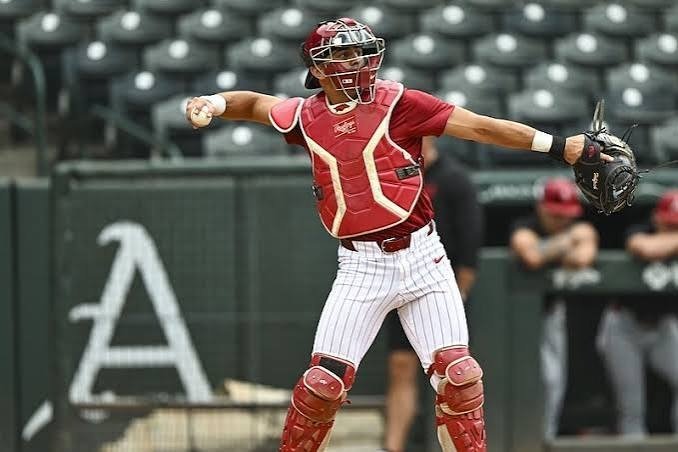
Photo by Hank Layton / WholeHogSports
Considered one of the best defensive catchers in the 2026 class, Ryder Helfrick is a power hitter (55 scouting grade vs 45) out of Arkansas. He also spent summers at the CACL and CCBL. He hit 32% less singles than the average round 1 draftee, 76% less doubles, 85% less triples, and had a .050 less batting average. However, he did hit 10% more home runs. He makes up for this with a 65 arm grade. Like most catchers, he’s not particularly fast, with a 40 run grade.
For the Diamondbacks, Chase Field having one of the longest outfields in the MLB is perfect for Helfrick because it tends to favor those who make hard contact. However, Arizona usually needs the roof closed, which could make Helfrick’s underwhelming single and double numbers a lot more obvious. With an average rank of 2nd in outfield length, average temperature, and elevation, that combination tends to favor hitters who hit a lot of triples, and that’s not Helfrick. That long outfield, combined with some of the highest walls in baseball, doesn’t tend to favor those who don’t have high batting averages. However, ranking 19th in minimum wall height, teams don’t tend to need baserunning to score runs.
Overall Fit Grade: D+
#53 Carson Kerce, SS – Georgia Tech

Photo by ACC/Georgia Tech Athletics
A contact hitter from Georgia, Carson Kerce hit 45% more doubles than the average Round 2 player. However, this also resulted in him hitting over 140% less home runs than the mean. Interestingly, his GIDP rate was higher than the average as well. He made the 2026 First Team All-ACC Team. During his 3 collegiate years, he also played summer ball at the SUNB, APPY, and CCBL.
Chase Field’s roof should be useful in encouraging Kerce’s double habits. However, it has the exact same properties that tend to favor hard contact, being in the hot desert, the field is built long so that balls that fly farther in Arizona, don’t always go over the fences. This unfortunately puts contact hitters like Kerce at a disadvantage. Those same properties, encourage high levels of triples, so Carson will have to adapt, or his lower triple rates could be painfully obvious. Being under the roof usually creates more double plays, so his tendency will blend in.
Overall Fit Grade: C
#88 Brayden Dowd, OF – Florida State
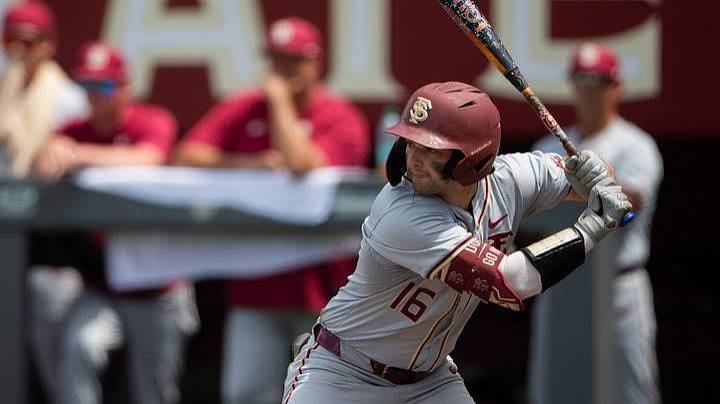
Photo by USA TODAY Network via Reuters Connect
The third year lefty out of Florida State was a summer league warrior, spending time at the GRCL, NWDS, CACL, and CCBL in his 3 collegiate seasons. A power hitter (50 vs 40 scouting grade – power vs hit), Dowd surprisingly hit 71% less doubles, and 51% less home runs than the average Round 2 player. In fact, he hit into 118% less double plays. His final year of college ball, he earned Third Team All-ACC honors.
Though his scouting grades tell a different story than his stats, being a power hitter is great in Arizona. He might have a similar issue as Kerce with his lack of doubles. He also might see an increase in GIDPs as well, being under the roof.
Overall Fit Grade: C
#236 Paul Schoenfeld, OF – West Virginia
Photo by WVU Athletics
After playing D2 at Colorado Mesa for 3 years, Paul Schoenfeld transferred to West Virginia for his final season of collegiate play. He also previously spent time at Butler Community College and 2 summers at the NWDS. Being a center field hitter, he tends to hit towards the deepest parts of the field, as he averaged 87% more triples than the average round 8 player. This also led to him hitting 67% less home runs than the average. He grounded into 156% less double plays.
“Staying locked in, focused on contact, and not chasing results” – Schoenfeld in an interview with Yahoo Sports
With the length of Chase Field’s outfield, Schoenfeld will have plenty of grass to hit the ball deep and leg out triples. The heat and elevation of Phoenix should also help Paul keep up his triple rates. However, like many other players drarted by Arizona, his GIDP numbers might see an uptick.
Overall Fit Grade: B
#266 Chris Katz, 1B – Mercer
Photo by Mercer University Athletics
Reigning SoCon Player of the Year, Chris Katz spent 4 years at Wake Forest before transferring to Mercer while he pursued his masters. A power-pull hitter, Katz owns a 40% pull-air, and a 54% hard-hit rate. The righty hit 60% more home runs than that average round 9 player, on his way to a Second-Team All-American honors. However, he also hit 117% less triples than the average.
As a righty pull hitter, Katz should benefit from Chase Field’s shorter distance from home plate to left field. Even though it has a short distance out to left field, it has an overall long outfield, which is usually beneficial to power hitters. However, those same conditions also encourage triples, which Katz does not hit many of.
Overall Fit Grade: C+
#326 Cody Boshell, 1B – Bishop Snyder High (Florida)
Photo via Maxpreps
Projected to be a power-pull hitter, Cody Boshell surprisingly hit 67% less home runs than the average high schooler drafted in the 11th round. He also hit 116% less triples and had a batting average .13 below the average. However, Perfect Game had great things to say about his potential: “Long and strong swing, aggressive getting to his bat speed, power approach with extension out front” (Perfect Game).
Like a lot of hitters drafted into Arizona who don’t hit a lot of triples, that trend might become obvious if he makes it up to the big leagues with the Diamondbacks. With one of the highest walls in the MLB, that usually encourages high batting averages, so Boshell would have to raise up his average to not stand out in a negative way. Unlike righty pull hitters, who’d benefit from the short distance from home plate to left field, the distance from home to right field is a lot farther, which tends to be detrimental for lefty pull hitters. He still gets to get the Arizona benefits for being a power hitter though.
Overall Fit Grade: D
#386 Jack Spanier, SS – Minnesota
Photo via Gopher Sports
A true contact hitter, Jack Spanier hit 328% less home runs than the round 13 draftee average. In his professional debut with Visalia, he “showed tremendous contact skills in his pro debut” (Baseball America). He spent two summers at the NWDS, and one at the NECL, while also being nominated to the Big Ten All-Freshman Team in 2024.
Being a contact hitter at Chase Field is usually disadvantageous due to the high temperatures and long outfields. Home runs are greatly encouraged by those same conditions. We’ll see if Spanier can become a worthy replacement of Geraldo Perdomo when the time comes
Overall Fit Grade: F
#536 Jake Duer, OF – Texas A&M
Photo via Meredith Seaver, The Eagle
Jake Duer spent 2 years at TCU before transferring to Florida Atlantic for a year, then finally transferring one more time to Texas A&M for his senior year season. A lefty contact hitter, Duer averaged .91 singles per game. That does mean his home runs rate was about 1/2 as the round 18 average
“Premier contact hitter” – Kendall Rogers on X
While being a contact hitter is disadvantageous in Arizona, single rates tend to be increased with the use of a roof, so Duer should continue to get hits. However, it still doesn’t seem like he’ll be able to take advantage of the home runs advantages Chase Field provides
Overall Fit Grade: D+
#566 Weber Neels, C – Minnesota
Photo via Gopher Sports
A hybrid hitter, Weber Neels has the ability to hit the ball to any part of the field. He earned Big-Ten All-Freshman Team honors in 2023, All Big-Ten Second Team in 2025, and All Big-Ten First Team in 2026. He spent a summer at the NWDS and one at the CCBL. He slashed 79% more home runs than the round 19 average, but 144% less triples. His GIDP rate was also almost double the average.
The final hitter drafted by the Diamondbacks, they made sure he would benefit from Chase Field’s beneficial conditions for home runs. However, like many hitters drafted by Arizona, he might struggle with his lack of triples, and high GIDP rate.
Overall Fit Grade: D
Note: The Diamondbacks drafted Rylan Alaniz with the 506th pick, but he elected to fulfill his collegiate commitment to Texas State
Diamondbacks Draft Grade Based on Player Fit: D+
**Data & Statistics Courtesy of:**
* [Sports Reference](https://sports-reference.com) (including [Baseball-Reference](https://baseball-reference.com))